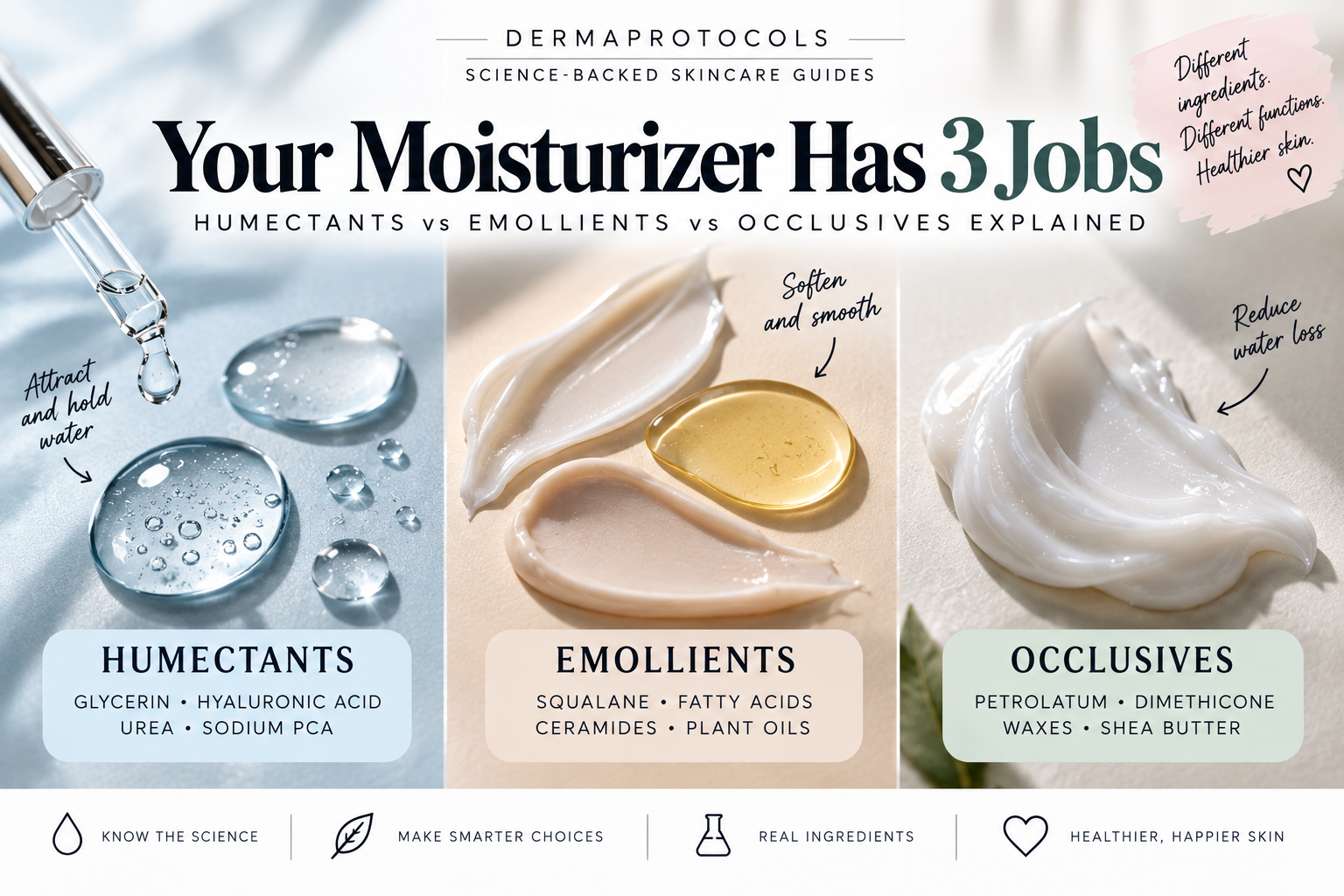
Your Moisturizer Has 3 Jobs: Humectants vs Emollients vs Occlusives Explained
Your hyaluronic acid serum says hydrating. Your moisturizer says hydrating. Your thick night balm also says hydrating.
So… are they all doing the same thing?
Not even close.
One can help increase water in the outer layer of your skin. Another can make a rough surface feel smoother. Another can slow down the water that keeps escaping from your skin in the first place.
And once you understand those three jobs, moisturizer labels suddenly make a lot more sense.
The 15-Second Version
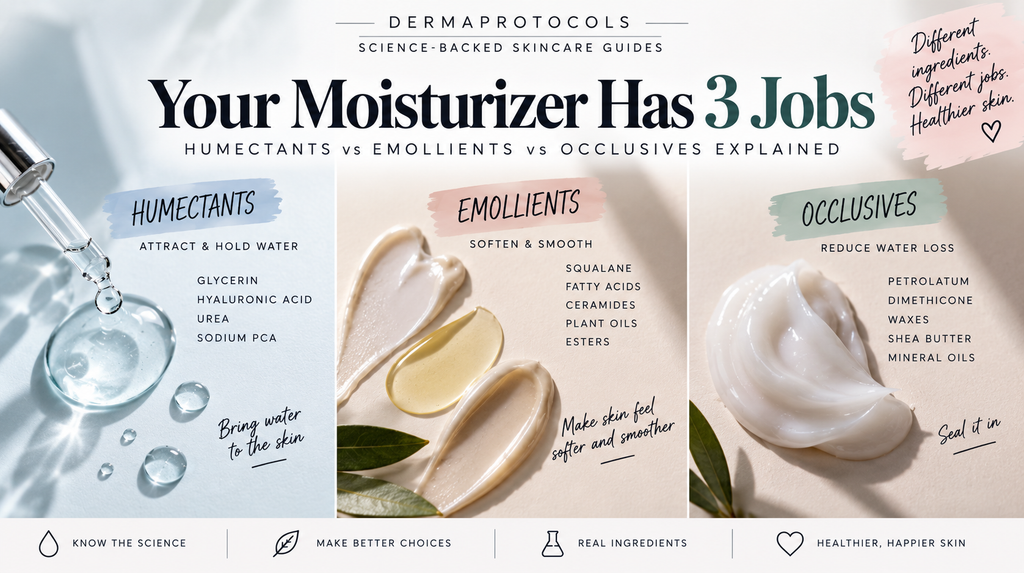
💧
HUMECTANTS
Help hold water.
Think glycerin, hyaluronic acid and urea.
🧴
EMOLLIENTS
Soften and smooth.
Think squalane and many skin-compatible lipids and oils.
🔒
OCCLUSIVES
Reduce water loss.
Petrolatum is the classic example.
Hydrate. Smooth. Seal.
That’s the basic idea.
The important part? A well-designed moisturizer may do all three. These are useful functional categories, not three completely separate worlds.
💧 Job #1: Humectants Help Your Skin Hold Water
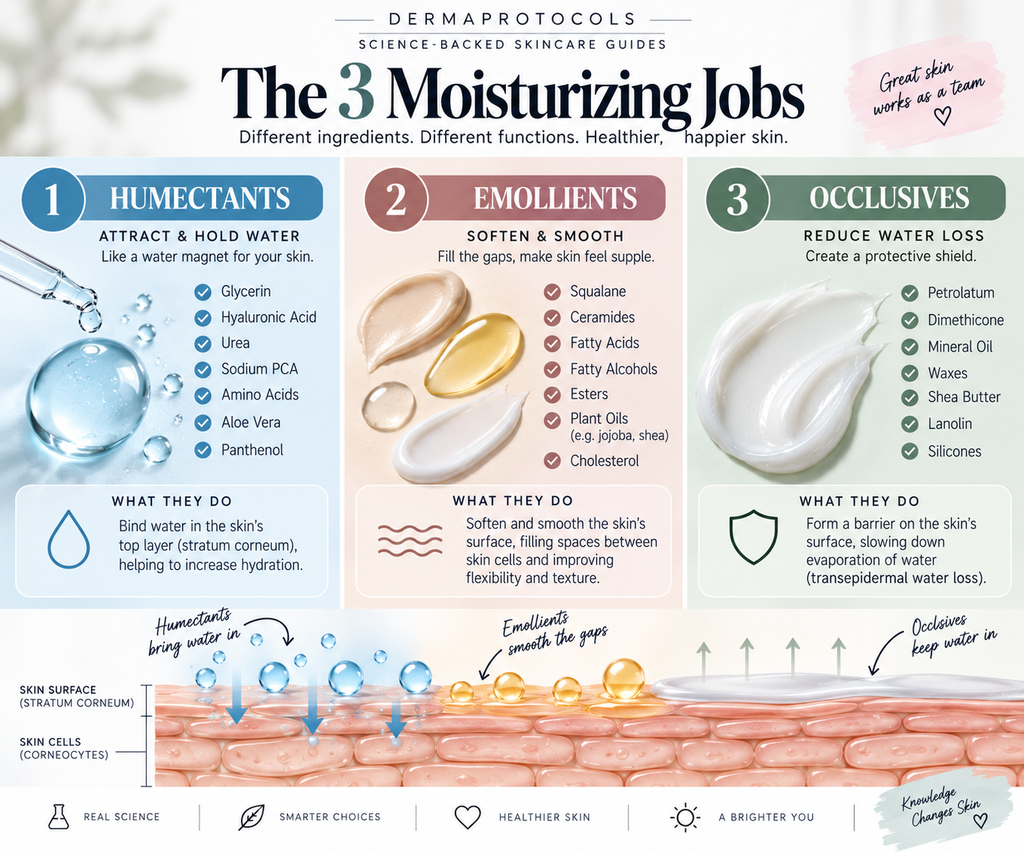
Humectants are ingredients that interact with water and help increase water retention in the stratum corneum — the outermost layer of your skin.
Common examples include:
Look for:
💧 Glycerin / glycerol
💧 Hyaluronic acid / sodium hyaluronate
💧 Urea
💧 Sodium PCA
💧 Other water-binding components depending on the formula
Glycerin is particularly interesting because it isn’t simply cosmetic label decoration. Human research has linked glycerol content in the stratum corneum with skin hydration, and topical glycerol has also been studied for effects on hydration and barrier recovery.
This is why humectant-rich serums can make dehydrated skin feel noticeably plumper and more comfortable.
💦 Using a hydrating serum?
Whether you apply it to wet or dry skin can cause plenty of confusion. Read: Should You Apply Skincare to Damp Skin? What Goes on Wet vs Dry Skin.
But Here’s Where the Internet Gets Humectants Wrong
You’ve probably heard something like:
“Hyaluronic acid attracts water — so that’s all you need for dehydration.”
Not necessarily.
Adding or retaining water within the outer skin is only part of the problem. Your skin is also continuously losing water to the environment through transepidermal water loss (TEWL).
So you can use a beautiful humectant serum and still feel dry or tight if the rest of your routine isn’t supporting water retention and the skin barrier.
💧 Think of it this way:
Hyaluronic acid can help bring water management to the party.
That doesn’t mean it knows how to keep everyone there.
🧴 Job #2: Emollients Smooth the Surface
Run your fingers over very dry skin.
It may feel rough, flaky or uneven because the outer skin isn’t behaving like a perfectly smooth sheet.
Emollient ingredients help soften and smooth that surface and can fill spaces between shedding skin cells, improving flexibility and feel.
Depending on the formulation, emollient materials may include ingredients such as squalane, fatty acids, fatty alcohols, esters and various oils and lipids.
Think:
💧 Humectant → “My skin needs more water support.”
🧴 Emollient → “My skin feels rough, flaky or uncomfortable.”
That doesn’t mean every oil behaves identically, or that one ingredient can be classified perfectly by a single word. Cosmetic formulations are more complicated than TikTok ingredient charts.
🔒 Job #3: Occlusives Slow the Escape
Now imagine your skin has water…
…but isn’t very good at keeping it.
Occlusive ingredients create a surface effect that can reduce water loss to the external environment. Petrolatum is the classic example and has been extensively studied for its effects on the stratum corneum and water loss.
This explains why an ointment can feel dramatically different from a lightweight gel.
The gel may provide a pleasant dose of hydration. The richer product may be much better at slowing evaporation.
🔒 IMPORTANT
Occlusive Doesn’t Mean “Bad” or “Pore-Clogging”
Occlusion describes a function. It doesn’t automatically tell you whether a finished product will cause acne, feel greasy, suit your skin type or work well under makeup.
Wait — Is Dimethicone an Occlusive?
This is a good example of why skincare categories become messy.
Silicones such as dimethicone are frequently placed into simple internet “occlusive” lists. But research comparing common silicone excipients with petrolatum found a clear difference: petrolatum behaved as a strong occlusive, while the tested silicones remained much more permeable to water vapor.
So rather than treating every ingredient chart as a rigid taxonomy, it is better to ask:
What is the finished formula actually designed to do?
🪞 The DermaProtocols Moisturizer Test
Forget the marketing words on the front of the jar for one minute.
How does your skin actually behave?
| What Your Skin Is Doing | What to Look For |
|---|---|
| Feels tight or dehydrated | Humectants + a well-formulated moisturizer |
| Feels rough, flaky or less flexible | More emollient support may help |
| Feels moisturized briefly, then dry again | Consider whether the routine provides enough water-loss protection |
| Oily but somehow still tight | Don’t automatically jump to the heaviest ointment — hydration and formulation matter |
| Very dry, compromised-feeling skin | A formula combining several moisturizing mechanisms may be more useful than a single “hero” ingredient |
So Which One Does Your Skin Need?
This is the trick question.
Probably not just one.
Moisturizers are formulations, not ingredient trading cards. A good product may combine humectants, emollients and ingredients that reduce water loss because those functions complement each other.
And studies of moisturizers show something else that matters: the finished formulation counts. Two creams marketed for dry skin can have different effects on hydration and barrier function depending on their composition.
So don’t choose a moisturizer simply because glycerin, ceramides or hyaluronic acid appears somewhere on the ingredient list.
The whole formula matters.
🛒 DON’T BUY ANYTHING YET
Your Serum May Not Be the Problem
If your skin feels beautifully hydrated for ten minutes and then tight again, buying a second hyaluronic acid serum may simply give you…
more of the same job.
Look at your moisturizer instead.
Does the routine contain ingredients that soften the skin and help reduce water loss? Are you cleansing too aggressively? Are strong actives making your barrier harder to manage?
Sometimes you don’t need another hydration step. You need a better hydration strategy.
What About Oily Skin?
Oily skin still needs water.
Sebum and hydration are not the same thing, which is why skin can feel oily and tight at the same time.
But that doesn’t mean every oily skin type needs a heavy petrolatum-rich ointment over the entire face.
A lighter moisturizer can combine humectants and emollient components while still being cosmetically comfortable.
If this sounds familiar, see Why Does My Skin Feel Dry Even When It’s Oily? The 3-Step Combination Skin Protocol .
And What About a Damaged Barrier?
Barrier problems are another reason the “just add hyaluronic acid” approach can feel disappointing.
When water loss and barrier function are part of the problem, the goal is not simply to make the skin feel wet for a few minutes.
This is where a thoughtfully formulated moisturizer — rather than one fashionable ingredient — becomes much more interesting.
💊 PHARMACIST’S REALITY CHECK
Stop Asking Which Ingredient Is “Best”
Glycerin isn’t competing with squalane.
Squalane isn’t competing with petrolatum.
They’re useful for different reasons — and in a good moisturizer, they may work together.
Your skin doesn’t need an ingredient winner.
It needs the right combination of jobs.
💧 HYDRATION LAB — THE CHEAT SHEET
Hydrate. Smooth. Seal.
💧 HUMECTANTS → HELP HOLD WATER
Glycerin • Hyaluronic Acid • Urea
🧴 EMOLLIENTS → SOFTEN & SMOOTH
Squalane • Lipids • Oils • Esters
🔒 OCCLUSIVES → REDUCE WATER LOSS
Petrolatum is the classic example
The best moisturizer isn’t necessarily the heaviest.
It’s the one doing the jobs your skin actually needs.
🔬 The Science Behind Moisturizers
Moisturizer Technology: Humectancy, Emolliency and Occlusion
This review describes humectants, emollients and occlusives as complementary mechanisms used in moisturizer technology, with humectants supporting water retention and occlusives reducing water loss.
View the review on PubMed →
Skin Hydration and Dermocosmetics
A 2026 review discusses skin hydration and the roles of humectants, emollients and occlusives in modern moisturizing cosmetics.
View the review on PubMed →
Glycerol and Stratum Corneum Hydration
Human research found an association between glycerol content in the stratum corneum and skin hydration, supporting glycerol’s importance in water balance.
View the study on PubMed →
Emollients and Moisturizers in Dry Skin Barrier Disorders
This review explains that moisturizers can contain multiple functional components and that their effects depend on the overall formulation, not simply a single ingredient.
View the review on PubMed →
Silicones vs Petrolatum and Occlusion
A human study comparing common silicone excipients with petrolatum found that petrolatum produced clear occlusive effects, while the tested silicones were substantially more water-vapor permeable.
View the study on PubMed →
Keep Reading
💦 Should You Apply Skincare to Damp Skin? What Goes on Wet vs Dry Skin
🚿 Why Does My Skin Feel Dry Even When It’s Oily? The 3-Step Combination Skin Protocol
🧴 CeraVe Hydrating Cleanser Review: The Gold Standard for Gentle Cleansing
Editorial note: Ingredient categories are useful for understanding moisturizer design, but cosmetic ingredients can have overlapping functions. The performance of a finished moisturizer depends on the complete formulation, concentrations, vehicle and how it interacts with your individual skin.


