Does Caffeine Actually Help Dark Circles and Eye Bags?
Your eye serum contains caffeine.
Your coffee contains caffeine.
Unfortunately, neither one can fill a tear trough. ☕👀
But topical caffeine isn’t completely hype either. The real question is what kind of under-eye problem you’re asking it to fix.
Caffeine may help some under-eye concerns. It cannot solve every reason your eyes look tired.
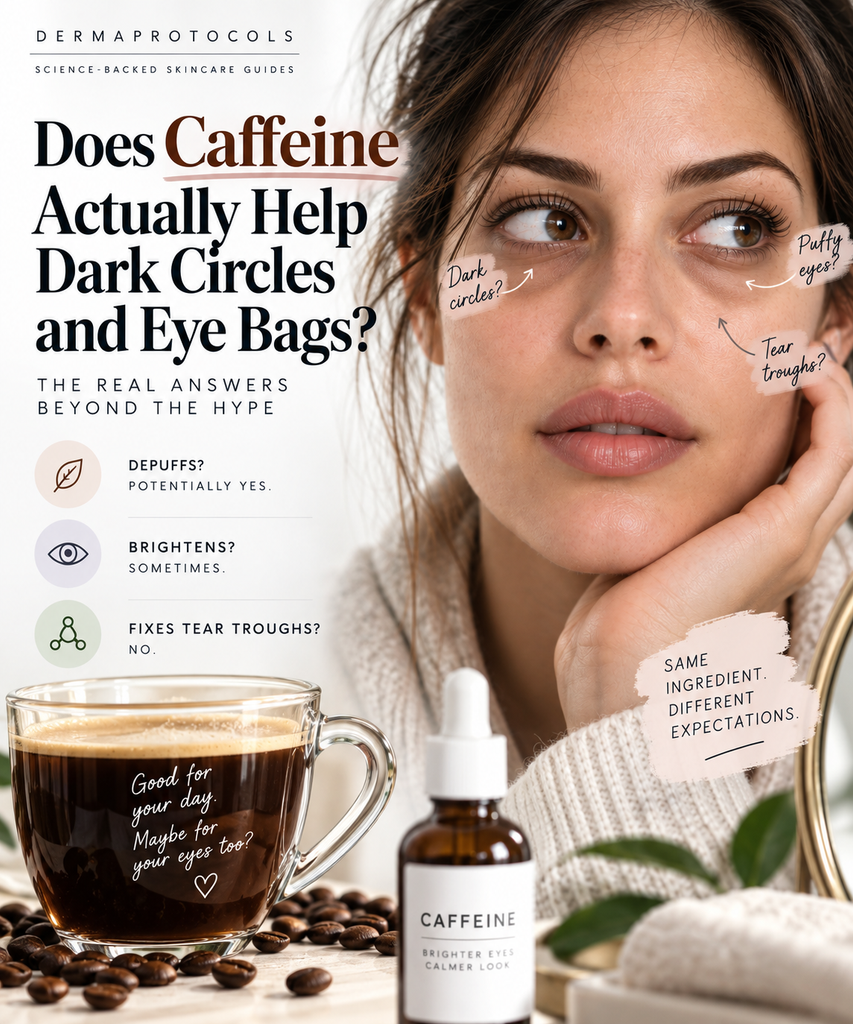
THE 20-SECOND ANSWER
What Can Caffeine Realistically Help?
🫧 Temporary puffiness?
Potentially useful.
🔵 Some vascular-looking darkness?
Possibly — depending on the cause and formulation.
🟤 Brown pigmentation?
Caffeine alone is unlikely to be the whole answer.
🌑 A deep tear trough?
No eye serum can remove the underlying structural hollow.
☕ Why Is Caffeine Even in Eye Serums?
Caffeine is not just something beauty brands borrowed from your morning espresso. It is a biologically active molecule that can penetrate skin and has been studied in topical formulations.
It is commonly included in eye products because of its effects on vascular physiology and its antioxidant properties.
Clinical literature on periorbital skincare also includes caffeine-containing formulations among topical approaches studied for under-eye discoloration and puffiness.
But “has biological activity” is not the same as “erases dark circles.”
Before choosing an eye serum: ask whether you’re seeing color, puffiness or a structural hollow. Those are different problems — and they don’t respond to the same strategy.
🫧 Where Caffeine Makes the Most Sense: Puffiness
This is probably caffeine’s most logical cosmetic use around the eyes.
If your under-eye area looks temporarily puffy — particularly at certain times of day — a caffeine-containing formula may help improve the appearance of that tired, swollen look.
That does not mean caffeine literally “drains” every eye bag.
Permanent or prominent bags can involve anatomy and protruding orbital fat, which is a very different problem from temporary puffiness.
If you’re considering a high-caffeine formula, we already looked closely at The Ordinary Caffeine Solution 5% + EGCG and where a product like this fits — and, importantly, where it doesn’t.
🔵 What About Dark Circles?
This is where things get more complicated.
“Dark circles” can be caused by pigment, visible vascular structures, thin skin, shadowing or a mixture of several factors.
So a caffeine serum may make more sense when vascular appearance or puffiness contributes to the darkness than when you’re dealing primarily with brown pigmentation or structural shadowing.
CAFFEINE IS NOT A DARK-CIRCLE UNIVERSAL REMOTE CONTROL.
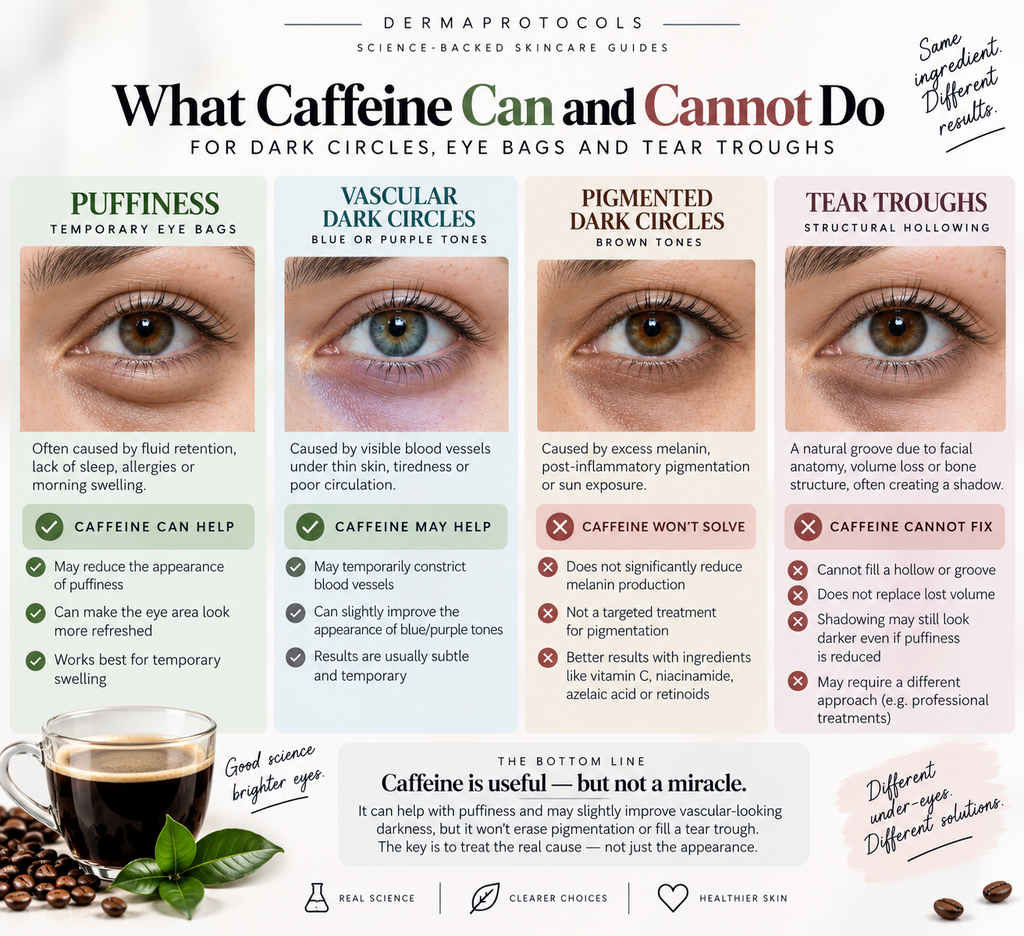
🔵 Vascular-looking / tired appearance → may be worth trying
🫧 Temporary puffiness → may help the appearance
🟤 Predominantly brown pigment → needs a pigment-focused strategy
🌑 Tear-trough shadow → caffeine cannot fill anatomy
🌑 Why Caffeine Won’t Fix a Tear Trough
Imagine shining a flashlight over a small valley.
The valley creates a shadow because of its shape, not because the ground suddenly developed more pigment.
A tear trough can work in a similar way.
Its contour can create under-eye shadowing, particularly under overhead lighting. A topical caffeine serum may affect the skin’s appearance, but it cannot physically replace missing volume or change the underlying anatomy.
You cannot de-puff a hollow.
🚨 THE CAFFEINE MYTH
“If It Tightens My Eyes, It Must Be Fixing My Dark Circles”
Not necessarily.
A temporary cosmetic improvement does not tell you that the underlying cause of your dark circles has disappeared.
And a product can make the eye area look fresher without correcting pigment, tear-trough anatomy or permanent eye bags.
Looking better ≠ every underlying cause has been treated.
📈 Is More Caffeine Better?
Not automatically.
A percentage printed on the front of a bottle doesn’t tell you everything about how well the finished product will perform.
Vehicle, supporting ingredients, stability, application amount and tolerability all matter.
And because the eye area is delicate, irritation from an unsuitable product can make the whole area look worse rather than better.
Your under-eyes don’t award bonus points for the biggest percentage on the bottle.
🧴 So Should You Buy a Caffeine Eye Serum?
It makes more sense if:
✓ Puffiness is one of your main concerns
✓ Your eyes look particularly tired or swollen at certain times
✓ You understand that the result may be subtle or temporary
✓ You want a lightweight eye product rather than a structural solution
Think twice if:
✗ Your main issue is a deep tear trough
✗ You’re expecting permanent removal of eye bags
✗ Your darkness is predominantly pigment and you’re ignoring pigmentation
✗ You’re buying it because TikTok said caffeine “deletes” dark circles
And if you’re choosing between treating dark circles and fine lines, that’s a different decision again. Our Beauty of Joseon Revive Eye Serum vs La Roche-Posay Pigmentclar Eyes comparison shows why an eye product aimed at wrinkles isn’t automatically the best choice for discoloration — and vice versa.
💊 PHARMACIST’S REALITY CHECK
Caffeine Isn’t Useless. It’s Just Oversold.
There is scientific interest in topical caffeine and caffeine-containing eye formulations.
The problem begins when a reasonable cosmetic ingredient gets marketed as a universal solution for every dark shadow under the eye.
Puffiness? Maybe.
Some vascular appearance? Possibly.
Pigment? Not by itself.
A structural hollow? No.
☕ EYE FILE VERDICT
Does Caffeine Work for Under-Eyes?
🫧 PUFFINESS → MAY HELP
🔵 VASCULAR-LOOKING DARKNESS → MAY HELP SOME
🟤 PIGMENT → NOT THE MAIN SOLUTION
🌑 TEAR TROUGHS → CANNOT CORRECT THE STRUCTURE
Caffeine isn’t the question.
The cause of your under-eye concern is.
🔬 What Does the Science Say?
Topical Therapies for Periorbital Dyschromia — 30-Year Review
A review of clinical literature on topical treatments for periorbital discoloration, including caffeine-containing approaches, while emphasizing the importance of matching treatment to the underlying cause.
View on PubMed →
A Review of Popular Eye-Cream Ingredients
A review evaluating commonly used periorbital ingredients including caffeine, retinoids, vitamin C, niacinamide, peptides and hyaluronic acid.
View on PubMed →
Topical Delivery of Caffeine
A pharmaceutical review examining caffeine’s properties and its delivery into and through the skin.
View on PubMed →
Caffeine + Vitamin K Eye-Pad Study
A small controlled study found improvement in under-eye appearance after four weeks, although the formulation contained multiple components and the study was small — so it should not be interpreted as proof that caffeine alone eliminates dark circles.
View on PubMed →
Keep Reading
☕ The Ordinary Caffeine Solution 5% + EGCG Review
⚖️ Beauty of Joseon Revive Eye Serum vs La Roche-Posay Pigmentclar Eyes
Editorial note: Under-eye darkness and puffiness are multifactorial. Pigmentation, vascular visibility, edema, skin thickness and facial anatomy may overlap. Topical caffeine should not be expected to correct every cause of an under-eye concern.