Purging, Breakout or Irritation? Your Skin Is Trying to Tell You Something
You started a new serum on Monday.
By Friday, you have six new bumps, two angry red patches and a chin that suddenly feels like sandpaper.
TikTok has an answer: “Don’t stop. Your skin is purging.”
Your skin would like a second opinion.
Because a reaction after starting skincare can mean several very different things — and treating every breakout as “purging” can keep an irritating product on your face far longer than it deserves.
🚨 DERMAPROTOCOLS REACTION FILE #02
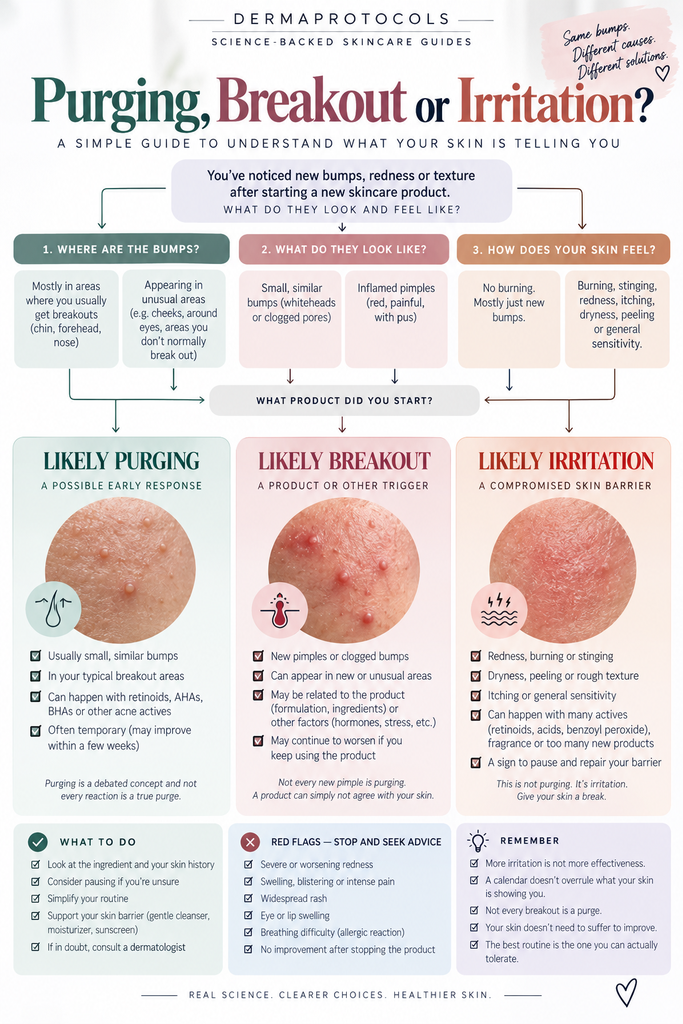
THE 30-SECOND SKIN REACTION DECODER
What Are You Actually Seeing?
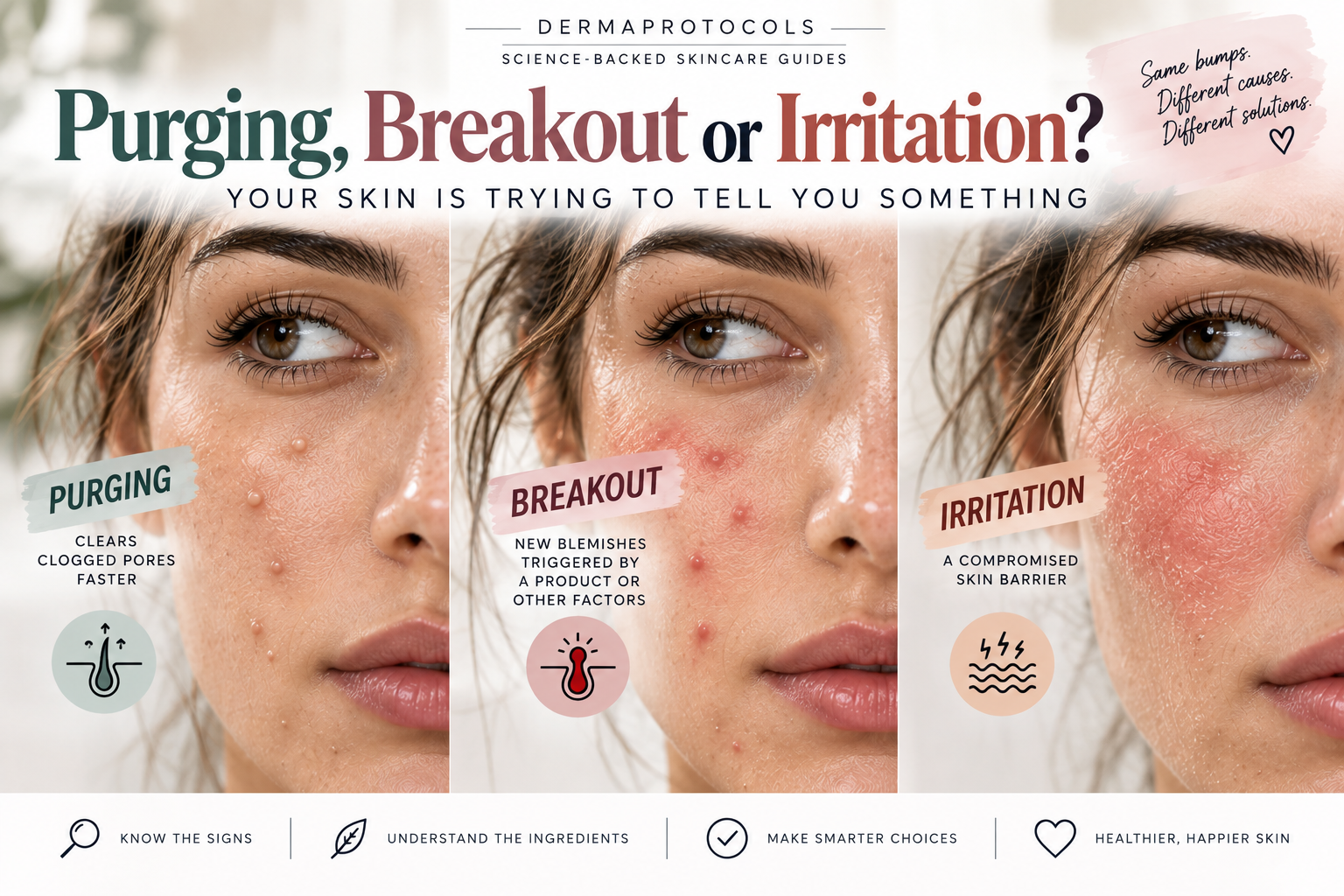
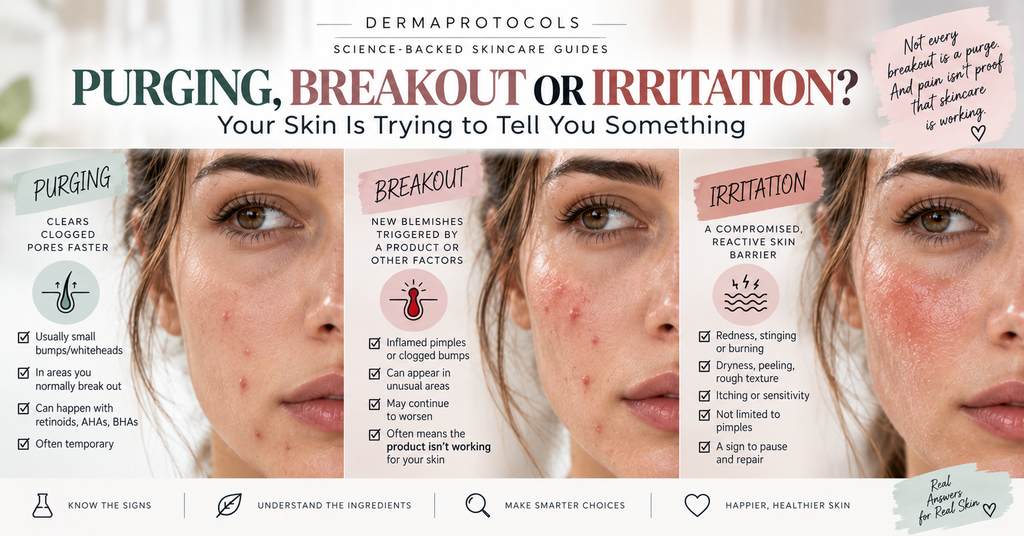
🔄 POSSIBLE “PURGING” / EARLY ACNE CHANGE
New acne lesions after starting an ingredient that genuinely affects comedones or skin-cell turnover — but don’t automatically assume this is the explanation.
🔴 BREAKOUT
New pimples or clogged bumps that may simply mean the product, formulation or changing acne pattern isn’t agreeing with your skin.
🔥 IRRITATION
Burning, stinging, redness, tightness, peeling, itching or diffuse roughness — especially beyond individual pimples.
First: “Purging” Is Not a Free Pass for Bad Skin Reactions
The internet often describes purging as if it were a mandatory detox phase: an active “brings everything to the surface,” your face gets worse, and beautiful skin appears if you suffer long enough.
That explanation is much too neat.
Topical retinoids can alter comedone formation and are established acne treatments. But interestingly, a review looking specifically for evidence of an initial retinoid-induced acne flare found no primary clinical-trial data supporting the common belief that topical retinoids inherently worsen acne when treatment begins.
Some people will certainly notice acne changing after starting a new active. But that doesn’t mean every new pimple proves the product is “working.”
🚨 The rule I want you to remember:
A breakout appearing after a new product does not automatically become
“purging” just because the product contains an active ingredient.
🔄 When Is “Purging” Even Plausible?
If you’re going to consider an early acne change related to treatment, start with the ingredient.
It makes considerably more biological sense with products that affect comedonal acne and epidermal turnover than with a basic moisturizer or hydrating serum.
MORE PLAUSIBLE CONTEXT:
🌙 Topical acne retinoids such as adapalene or tretinoin
🧪 Exfoliating acids used for acne/comedones, depending on the formulation
🩺 Other established acne treatments that can change lesion patterns during treatment
“PURGING” IS A MUCH WEAKER EXPLANATION FOR:
💧 A plain hydrating serum
🧴 A basic moisturizer
🌿 A soothing essence
🫧 A gentle cleanser
Your moisturizer does not need six weeks to “push toxins out.”
🔴 What Does a Regular Breakout Look Like?
This is where things become less satisfying, because ordinary acne doesn’t come with a perfect stopwatch.
A breakout may appear as closed comedones, inflamed pimples or clusters of bumps. It may coincide with a new product — but hormones, stress, occlusion, other products and your underlying acne can also change at the same time.
A few clues make me more suspicious of the new product:
* You’re getting repeated new lesions after introducing it
* The reaction continues rather than settling
* The product isn’t an acne treatment where an early change would even be plausible
* Things improve when the suspected product is removed
None of those alone proves causation. Skin is annoyingly bad at providing controlled experiments.
🔥 Irritation Looks Different — and This Is the One People Keep Calling “Purging”
Now we’re talking about something much better documented.
Topical retinoids can cause erythema, dryness, itching, stinging and peeling, particularly during the early treatment phase. Other acne treatments, including benzoyl peroxide and exfoliating products, can also irritate skin.
That is not your pores “detoxing.”
🔥 IRRITATION CLUES
BURNING • STINGING • REDNESS • TIGHTNESS • PEELING • ITCHING • DIFFUSE ROUGHNESS
You can have acne and irritation at the same time, which is exactly why looking only at the number of pimples can be misleading.
🔥 Does everything suddenly burn when you apply it?
That’s no longer just a “new pimples” question. See:
Why Does My Skin Burn After Everything I Apply? The 3-Step Sensitive Skin Rescue Protocol
🪞 The Mirror Test: Purging, Breakout or Irritation?
| What You Notice | Think About |
|---|---|
| New acne after starting a true acne active | Early treatment change is possible — but don’t assume |
| New bumps after a basic moisturizer | Ordinary breakout/product mismatch is more plausible than “purging” |
| Burning + redness + peeling | Irritation |
| Itching + rash-like reaction | Think beyond acne — irritation or contact dermatitis may need consideration |
| Persistent worsening | Reassess rather than endlessly waiting for a “purge” to finish |
⏳ But Doesn’t Purging Last 4–6 Weeks?
You’ve probably seen that number everywhere.
I would not use it as a universal countdown.
Acne lesions develop over time, acne itself fluctuates, and different treatments work on different timelines. There isn’t a magic date on which every legitimate “purge” must disappear.
More importantly, a calendar should never overrule what your skin is showing you.
If you’re experiencing significant burning, escalating redness, marked peeling, swelling or a worsening rash, “wait another four weeks” is not intelligent skincare advice.
🌙 Retinoids: The Biggest Source of Confusion
Retinoids deserve special attention because they are both effective acne treatments and well-known potential irritants.
Research consistently documents local irritation during the early phase of topical retinoid treatment, including dryness, erythema, itching and stinging. Modern guidance therefore focuses heavily on improving tolerability through gradual introduction, moisturization, gentle cleansing and photoprotection.
In other words:
Peeling is not your progress bar.
A retinoid does not need to make your face visibly miserable to prove that it is active.
If you’re exploring gentler vitamin A options, see our CeraVe Skin-Renewing Retinol Serum Review and Medik8 Crystal Retinal 3 Review .
🧪 What About BHA and Acid Serums?
Salicylic acid can be useful for clogged pores and acne-prone skin, but again, irritation is not the goal.
If you’re choosing between different acid-based approaches rather than stacking everything together, our Paula’s Choice 2% BHA vs La Roche-Posay Effaclar Serum breaks down two very different exfoliating strategies.
🛑 THE “SHOULD I KEEP GOING?” CHECK
Before You Push Through, Ask Four Questions
1. Is this product actually capable of changing acne lesion formation?
2. Am I seeing pimples — or burning, redness and peeling?
3. Is the reaction mild and manageable, or clearly getting worse?
4. Am I continuing because the evidence makes sense — or because social media told me suffering means results?
“Push through” is not a skincare ingredient.
🚨 When Should You Stop Experimenting?
Mild dryness with some acne treatments is very different from a significant skin reaction.
Stop treating the situation like a cosmetic puzzle and seek professional advice if you develop marked swelling, blistering, severe pain, widespread rash, eye or lip swelling, breathing difficulty, or a reaction that is persistent or progressively worsening.
And if acne itself is moderate, severe, painful, scarring or not responding to over-the-counter care, a dermatologist can do considerably more than another TikTok hack.
💊 PHARMACIST’S REALITY CHECK
Stop Calling Every Bad Reaction a Purge
If a retinoid gives you some early dryness, that can fit its known irritation profile.
If your face is burning, red and peeling, you have evidence of irritation — not evidence that the product is “cleansing toxins.”
And if a random moisturizer suddenly gives you repeated new bumps, you don’t need to invent a detox mechanism to justify continuing it.
Your skin doesn’t know the word “purging.”
It only knows what the product is doing to it.
🚨 REACTION FILE #02 — THE VERDICT
Purging, Breakout or Irritation?
🔄 TRUE ACNE ACTIVE + NEW LESIONS → EARLY CHANGE IS POSSIBLE
🔴 NEW BUMPS + NO CLEAR TURNOVER MECHANISM → BREAKOUT MORE PLAUSIBLE
🔥 BURNING + REDNESS + PEELING → THINK IRRITATION
🚨 SEVERE / SWOLLEN / PAINFUL / WORSENING → GET HELP
Not every breakout is a purge.
And pain is not proof that skincare is working.
🔬 The Science Behind the Reaction
Do Topical Retinoids Really Cause an Initial Acne “Flare”?
A review specifically investigating this common belief found no primary clinical-trial evidence supporting a predictable initial worsening of acne caused by starting topical retinoids.
View on PubMed →
Topical Retinoids: Efficacy and Safety
Clinical evidence supports topical retinoids as established acne treatments while also documenting local adverse effects including erythema, dryness, itching and stinging, particularly early in treatment.
View on PubMed →
Retinoid Tolerability
A review of 34 clinical studies found that cutaneous irritation can occur during the first weeks of topical retinoid treatment, with tolerability affected by formulation, concentration and skin type.
View on PubMed →
Managing Retinoid Irritation
A 2024 expert consensus emphasizes gradual application, moisturization, appropriate cleansing and photoprotection to improve tolerability and adherence.
View on PubMed →
Irritant Contact Dermatitis From Acne Treatments
A dermatology review describes erythema, burning, dryness, scaling and itching as characteristic features of irritant contact dermatitis associated with topical acne therapy.
View on PubMed →
Keep Reading
🔥 Why Does My Skin Burn After Everything I Apply? The 3-Step Sensitive Skin Rescue Protocol
🌙 CeraVe Skin-Renewing Retinol Serum Review
🧪 Paula’s Choice 2% BHA vs La Roche-Posay Effaclar Serum
Editorial note: Visual clues can help you think about a skincare reaction, but they cannot diagnose acne, irritant contact dermatitis or allergic contact dermatitis. Significant or persistent reactions should be assessed by an appropriate healthcare professional.