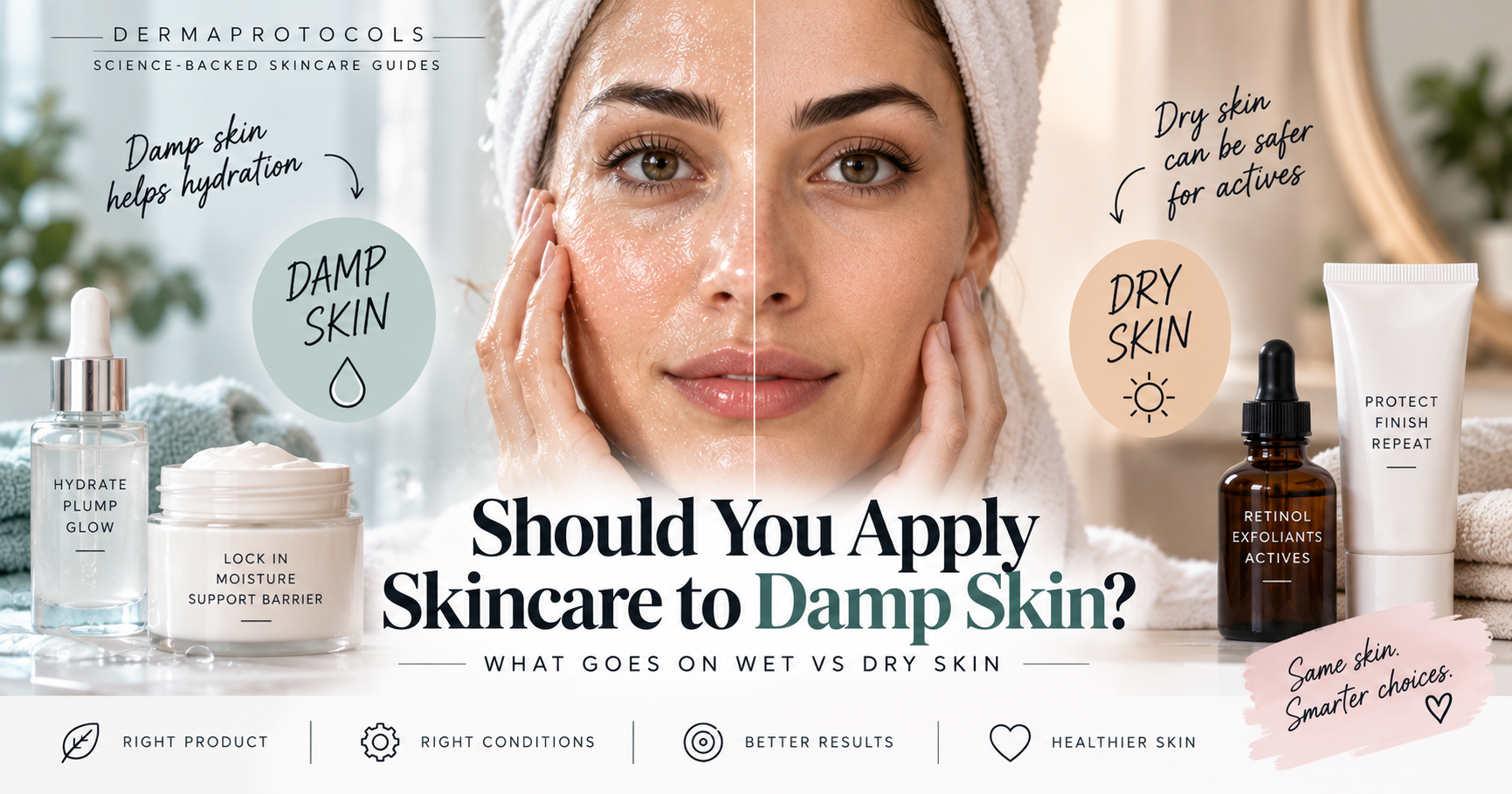
Should You Apply Skincare to Damp Skin? What Goes on Wet vs Dry Skin
“Apply hyaluronic acid to damp skin.”
Good advice.
Then somehow the internet turned it into: “Apply EVERYTHING while your face is still wet.”
That’s where things get messy.
Damp skin can be useful for hydration. It is not automatically the best surface for every active in your bathroom.
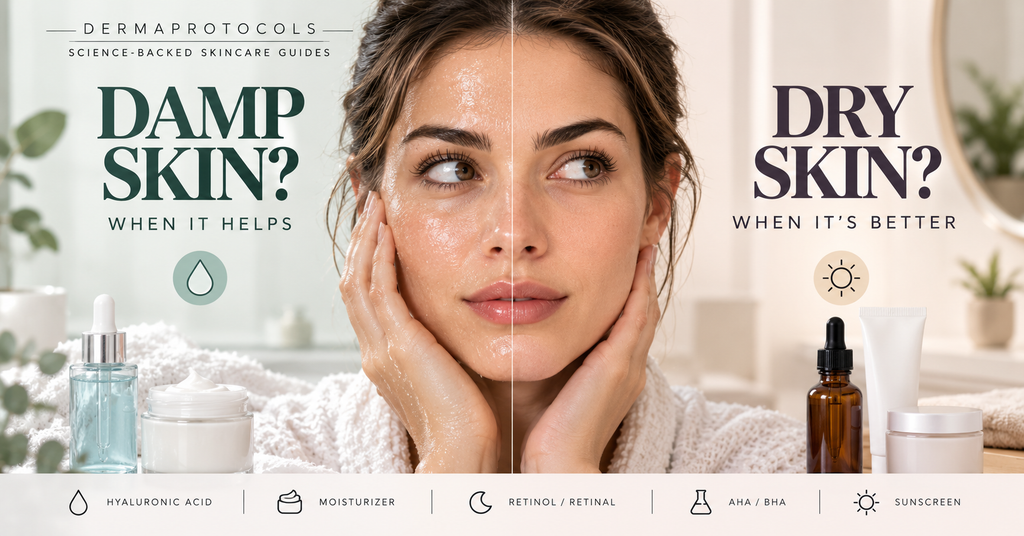
THE BATHROOM CHEAT SHEET
Damp or Dry?
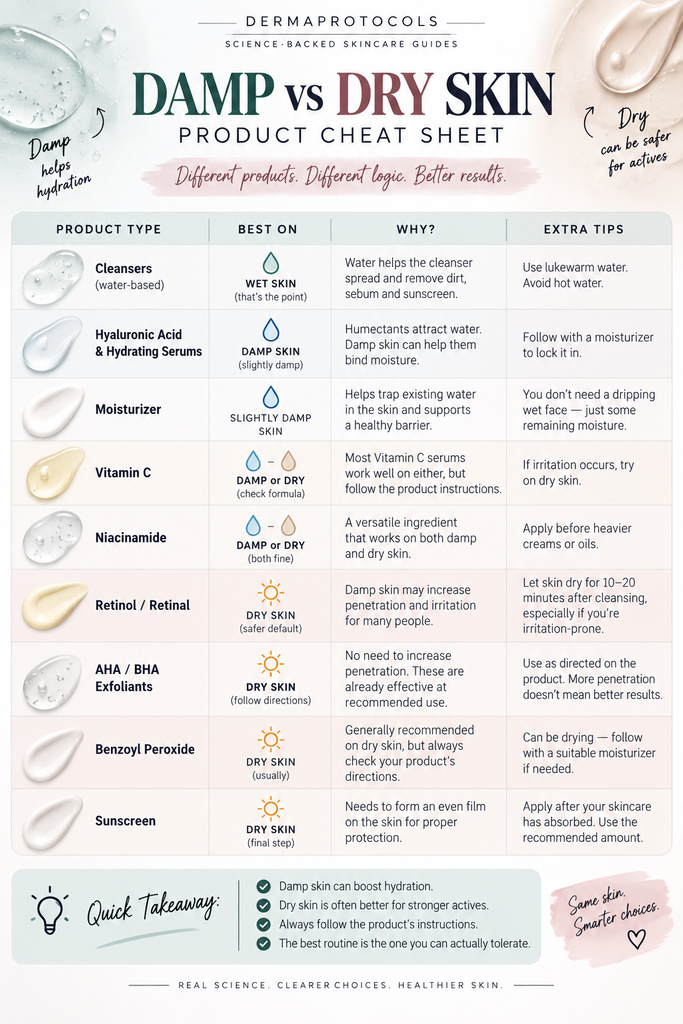
💧 MOISTURIZER → SLIGHTLY DAMP SKIN
A very sensible time to apply it.
💦 HYALURONIC ACID / HYDRATING SERUM → DAMP IS OFTEN FINE
Especially when followed by moisturizer.
🌙 RETINOL / RETINAL → DRY SKIN IS THE SAFER DEFAULT
Particularly if you’re irritation-prone.
🧪 AHA / BHA → FOLLOW THE PRODUCT DIRECTIONS
There is no prize for making an exfoliating acid penetrate more aggressively.
☀️ SUNSCREEN → NOT ON A DRIPPING-WET FACE
Apply as the final skincare step according to the product directions.
💧 First: What Does “Damp Skin” Actually Mean?
Not dripping.
Not water running down your cheeks.
Think freshly cleansed, gently patted skin that still contains a little surface moisture.
That distinction matters because the useful advice around damp skin originally makes most sense in the context of moisturization and water retention.
The American Academy of Dermatology recommends applying moisturizer while skin is still damp after washing or bathing to help trap water in the skin.
💡 The important word is MOISTURIZER.
“Moisturizer works well after washing” did not secretly mean “rush to apply every acid and retinoid before your face dries.”
And what you cleanse with matters too. If washing already leaves your face tight and uncomfortable, application timing isn’t the first problem I’d fix. Our CeraVe Hydrating Cleanser Review looks at a gentler, barrier-focused approach to cleansing.
🧴 Why Moisturizer Loves the Post-Shower Window
A moisturizer doesn’t simply “add water.”
Depending on the formula, it can combine:
💦 Humectants — ingredients such as glycerin and hyaluronic acid that help increase water content in the outer skin.
🧴 Emollients — help smooth and soften the spaces between skin cells.
🛡️ Occlusive ingredients — help reduce water loss from the skin surface.
Applying a moisturizer shortly after washing therefore makes intuitive and clinical sense: you are helping retain some of the water already present.
In one study examining moisturizer timing, stratum corneum water content was higher when moisturizer was applied immediately after bathing compared with waiting 90 minutes.
For moisturizer, you don’t need to wait for your face to become desert-dry.
💦 What About Hyaluronic Acid?
This is the ingredient that started most of the damp-skin conversation.
Hyaluronic acid is a humectant and is widely used in topical products to support skin hydration.
Applying a hydrating HA serum to slightly damp skin can fit very naturally into a routine — particularly when you follow it with a moisturizer.
But there is one internet claim I’d retire:
❌ “If you use hyaluronic acid on dry skin, it will suck all the water out of your face.”
That’s far too dramatic.
How a finished product behaves depends on the whole formulation,
the environment and what you apply around it — not on a cartoon image
of one HA molecule stealing your skin’s water supply.
The practical strategy is much less exciting: use your hydrating serum as directed and follow with an appropriate moisturizer.
🌙 Retinol and Retinal Are Where I Would Stop Following the Damp-Skin Rule
Now we have a different objective.
With a hydrating product, we’re trying to improve comfort and water retention. With a retinoid, we’re introducing an active that can already cause dryness, peeling, redness and irritation, particularly when you’re starting.
For an irritation-prone beginner, applying a retinoid to clean, dry skin is the more conservative approach.
🌙 RETINOID REALITY CHECK
More penetration is not automatically the goal.
If an application trick makes an already irritating active harder for your skin to tolerate, you haven’t “hacked” your routine.
You’ve potentially just made consistency harder.
If you’re starting vitamin A, the product itself matters more than chasing maximum intensity. We’ve looked at two relatively approachable options in the CeraVe Skin-Renewing Retinol Serum Review and the Medik8 Crystal Retinal 3 Review .
🧪 What About AHA and BHA?
This is another category where I wouldn’t turn “damp skin increases absorption” into a skincare goal.
Glycolic acid, lactic acid and salicylic acid products are already formulated to exfoliate.
If the manufacturer’s directions specify application to clean, dry skin, there is no compelling reason to improvise by deliberately wetting your face first.
Your exfoliant’s job is not improved by making your face unnecessarily angry.
☀️ And Sunscreen?
Sunscreen deserves its own rule because you’re asking the product to form an even protective film over the skin.
Apply it as the final skincare step according to the directions on the specific product. You do not need to keep your face deliberately wet for sunscreen application.
If your moisturizer underneath is still extremely wet or slippery, rushing another layer on top can also make the routine messy and contribute to uneven application or pilling with some product combinations.
🚿 THE DERMAPROTOCOLS 60-SECOND BATHROOM TEST
You Just Washed Your Face. What Now?
Using a hydrating serum?
→ Slightly damp is fine.
Using moisturizer?
→ Don’t wait unnecessarily. Apply while some moisture remains.
Using a retinoid?
→ If irritation is a concern, let the skin dry first.
Using an exfoliating acid?
→ Follow the formula’s instructions rather than inventing an absorption hack.
Using sunscreen?
→ Finish the routine with the recommended amount on a surface where it can spread evenly.
🚨 When Damp Skin Can Backfire
The biggest mistake isn’t damp skin itself.
It’s assuming that anything that increases penetration must improve results.
With strong or potentially irritating actives, greater exposure can also mean greater irritation.
This becomes especially relevant if your routine already contains several actives or your skin barrier is struggling.
The strongest routine is useless if you can’t tolerate using it.
🧠 Damp-Skin Myths: Keep or Delete?
| Claim | Verdict | Why |
|---|---|---|
| “Moisturize after washing” | ✅ KEEP | Helps retain water after cleansing |
| “Hyaluronic acid must NEVER touch dry skin” | ❌ DELETE | Far too absolute; formulation and routine matter |
| “Damp skin makes every active work better” | ❌ DELETE | More penetration can also mean more irritation |
| “Retinoids should sting to work” | ❌ DELETE | Irritation is a side effect, not a performance marker |
| “Product instructions matter” | ✅ DEFINITELY KEEP | Different formulas are designed to be used differently |
💊 PHARMACIST’S REALITY CHECK
Stop Treating “Damp Skin” Like a Universal Rule
For hydration, slightly damp skin can be useful.
For potentially irritating actives, deliberately maximizing penetration isn’t necessarily desirable.
And for every product, the finished formulation and its instructions matter.
Damp for hydration.
More cautious with strong actives.
No bathroom chemistry degree required.
💧 ROUTINE LAB VERDICT
Damp Skin or Dry Skin?
💦 HYDRATING SERUM → DAMP IS FINE
🧴 MOISTURIZER → SLIGHTLY DAMP
🌙 RETINOID → DRY IS THE SAFER DEFAULT
🧪 EXFOLIATING ACID → FOLLOW THE FORMULA
☀️ SUNSCREEN → FINAL STEP, EVEN APPLICATION
Your face doesn’t need one rule.
Your products need the right conditions.
🔬 The Science Behind Damp-Skin Application
Optimal Timing of Moisturizer Application
A study examining moisturizer timing found higher stratum corneum water content when moisturizer was applied immediately after bathing rather than 90 minutes later.
View the study →
American Academy of Dermatology — Dry Skin Guidance
Dermatologists recommend applying moisturizer while the skin is still damp after washing or bathing to help retain water.
Read the AAD guidance →
Moisturizers During Retinoid Treatment
Clinical research found that moisturizer use improved dryness, roughness, desquamation and skin comfort in people receiving topical tretinoin or oral isotretinoin.
View on PubMed →
Barrier Support During Tretinoin Therapy
A randomized study found that improving barrier function before and during tretinoin treatment helped reduce early tolerability problems and supported treatment use.
View on PubMed →
Keep Reading
🫧 CeraVe Hydrating Cleanser Review: The Gold Standard for Gentle Cleansing?
🌙 CeraVe Skin-Renewing Retinol Serum Review: Gentle Anti-Aging
✨ Medik8 Crystal Retinal 3 Review: The Gold Standard for Vitamin A Beginners
Editorial note: Application instructions vary by formulation. Prescription treatments should be used according to their label and the advice of the prescribing healthcare professional.