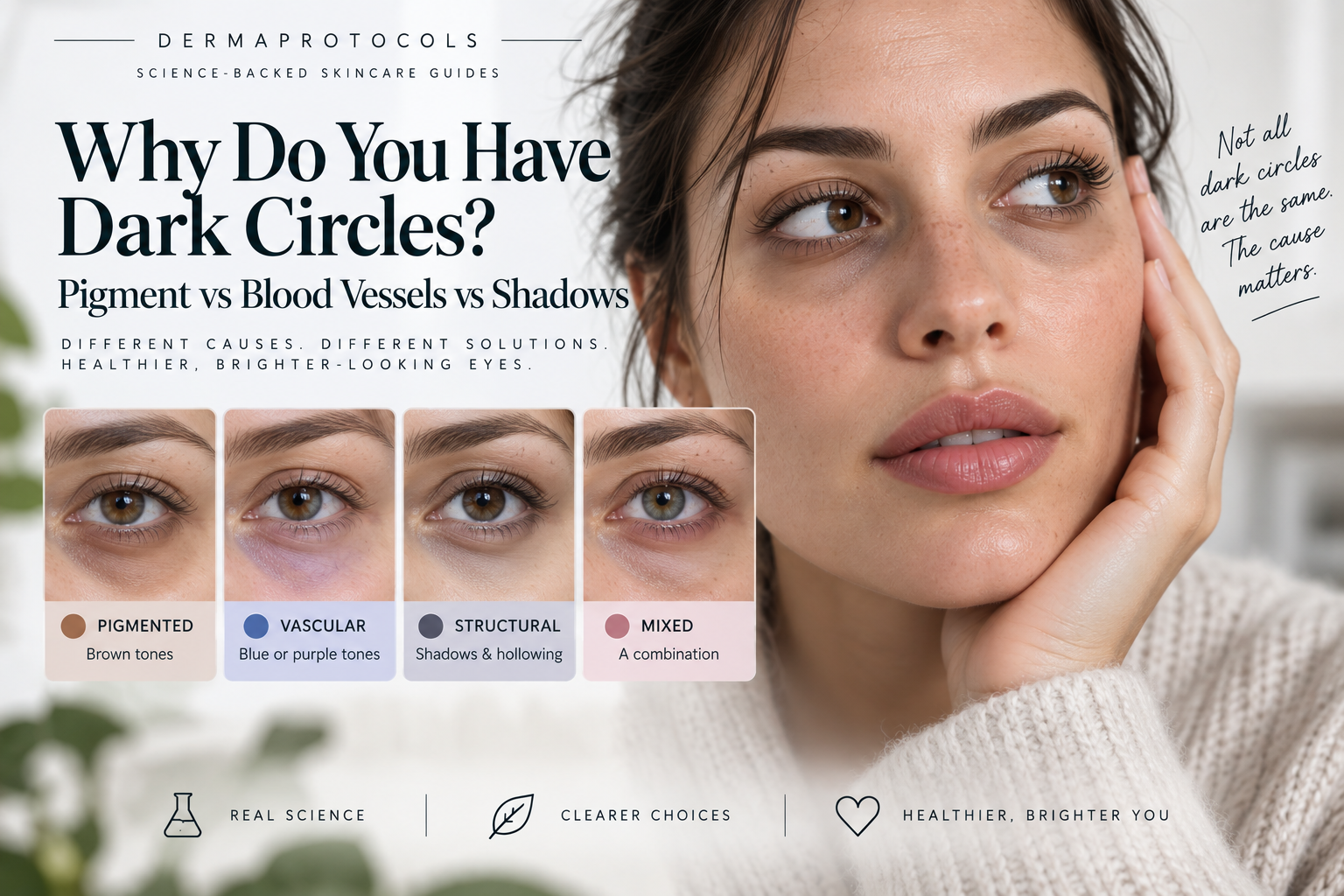
Why Do You Have Dark Circles? Pigment vs Blood Vessels vs Shadows
You look tired.
Except… you aren’t.
You slept eight hours, drank your water and still have that shadow under your eyes. So you buy another brightening eye cream.
But here’s the problem:
Not every dark circle is actually a pigmentation problem.
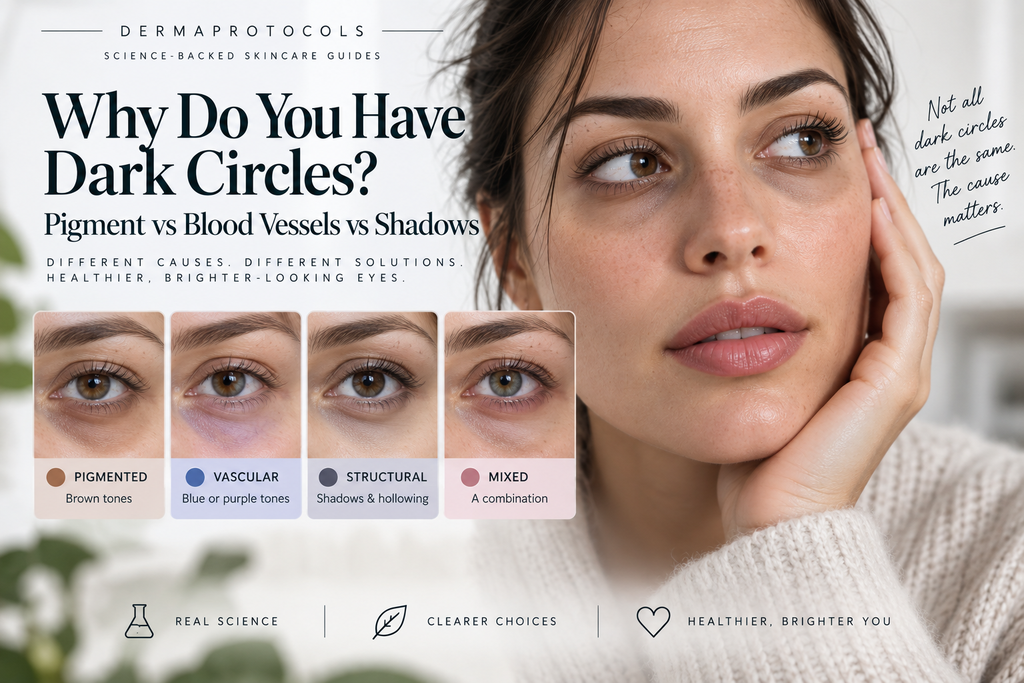
What Kind of Dark Circle Might You Be Seeing?
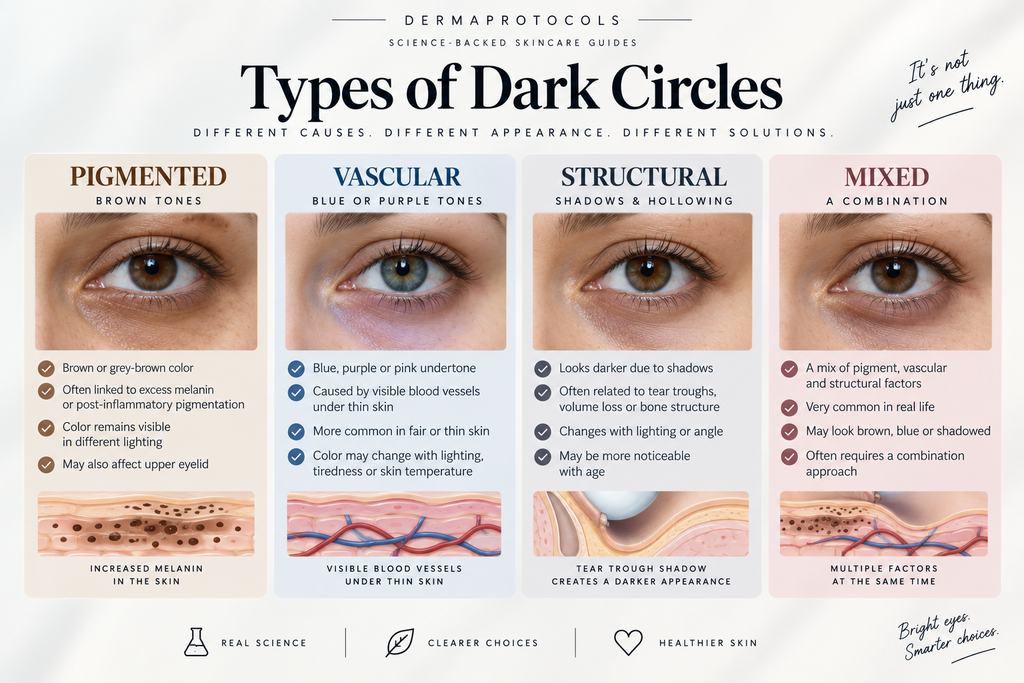
🟤 Brown / grey-brown color?
A pigment component may be contributing.
🔵 Blue, purple or pink undertone?
A vascular or thin-skin component may be involved.
🌑 Looks much darker in certain lighting or angles?
Structural shadowing may be part of the picture.
🔀 Looks like a bit of everything?
Welcome to the most realistic category: mixed dark circles.
This is not a home diagnosis. Dark circles can have multiple causes at once, and clinical assessment may include color, anatomy, skin thickness, shadowing, edema and other features.
🤔 Why One Eye Cream Doesn’t Work for Everyone
Dark circles are an appearance, not one single biological problem.
Medical literature describes several possible contributors, including excess pigmentation, thin translucent skin, superficial blood vessels, tear-trough anatomy, skin laxity and shadowing.
That explains why two people can both say “I have dark circles” while actually dealing with very different problems.
If your main problem is a shadow, a brightening serum cannot remove the shadow.
🟤 Type 1: Pigmented Dark Circles
Pigmented dark circles tend to look more brown or grey-brown.
Possible contributors include constitutional pigmentation and post-inflammatory pigmentation — for example after repeated rubbing, eczema or irritation around the eyes.
CLUES THAT PIGMENT MAY BE INVOLVED:
✓ Brown rather than blue-purple tone
✓ Color stays relatively visible in different lighting
✓ History of rubbing or irritation may be relevant
✓ Pigmentation may also affect the upper eyelids
This is where a targeted brightening eye product makes more logical sense than it would for a deep structural hollow. For example, our La Roche-Posay Pigmentclar Eyes Review looks specifically at a product positioned for visible dark circles and tired-looking under-eyes — while also explaining why it is a poor match when hollow tear troughs are the main issue.
The important part is not simply buying something labelled “brightening.” It’s matching the product to what you’re actually seeing.
🔵 Type 2: Vascular / Thin-Skin Dark Circles
Sometimes what you’re seeing isn’t extra brown pigment at all.
The lower-eyelid skin is naturally thin, and underlying vascular structures can contribute to a blue, violet or pinkish appearance.
CLUES THAT A VASCULAR COMPONENT MAY BE INVOLVED:
✓ Blue, purple or pink undertone
✓ Very thin-looking under-eye skin
✓ Visible vessels
✓ Appearance may change depending on lighting and skin tension
This is one reason treating every dark circle as “hyperpigmentation” can be disappointing.
A pigment serum cannot erase anatomy underneath translucent skin.
🌑 Type 3: Structural Dark Circles — The Shadow Problem
This one is especially easy to misunderstand.
A tear trough, volume loss, under-eye bags, skin laxity or simply the natural shape of the eye socket can create a shadow.
The skin may therefore appear darker even when pigment itself isn’t the main problem.
CLUES THAT SHADOWING MAY BE CONTRIBUTING:
✓ Darkness changes dramatically with overhead vs frontal lighting
✓ The hollow itself seems more obvious than the color
✓ Turning your face changes the apparent severity
✓ Tear troughs or under-eye bags are clearly visible
This distinction matters because skincare can improve the condition and appearance of the skin — but a topical serum cannot simply erase facial anatomy.
🔀 Type 4: Mixed Dark Circles
And then there’s real life.
You can have:
pigment + visible vessels
or
pigment + tear-trough shadowing
or
thin skin + puffiness + shadowing
or a combination of several factors.
Clinical classifications of periorbital dark circles include a mixed type for exactly this reason.
That’s also why “What’s the best eye cream for dark circles?” is often the wrong first question.
🪞 THE DERMAPROTOCOLS MIRROR TEST
Useful Clues — Not a Diagnosis
Stand in soft frontal daylight.
Then move under stronger overhead lighting and turn your face slightly.
Does the darkness change dramatically?
→ Shadowing may be contributing.
Does a brown tone remain obvious?
→ Pigment may be contributing.
Does it look more blue-purple?
→ A vascular/thin-skin component may be contributing.
And if the answer seems to be “all three” — that is entirely possible.
🚨 THE BIG DARK-CIRCLE MISTAKE
Treating Every Under-Eye Shadow Like Pigmentation
Brightening ingredients can make sense when pigment is genuinely involved.
But if the main issue is structural hollowing or shadowing, a serum may improve skin quality without making the anatomy disappear.
The treatment has to match the cause.
🫧 What About Eye Bags and Puffiness?
Puffiness can make dark circles look worse because it changes the contours around the eye and creates additional light-and-shadow contrast.
But eye bags are not the same thing as dark circles.
Fluid retention, fat-pad prominence and structural anatomy can all alter the appearance of the lower eyelid.
This distinction matters because trying to “brighten away” a shadow created by a bag or hollow may lead to a lot of product buying — and not much visual change.
☕ Does Caffeine Actually Fix Dark Circles?
Not universally.
Caffeine is common in eye products, but its usefulness depends on what is creating the tired-looking appearance in the first place.
This is exactly why our The Ordinary Caffeine Solution 5% + EGCG Review focuses primarily on puffiness and tired-looking eyes rather than pretending caffeine can correct every type of dark circle.
If your main issue is brown pigmentation, caffeine isn’t automatically the answer.
And if you’re seeing a deep tear-trough shadow, caffeine cannot fill the hollow.
Useful ingredient? Potentially.
Universal dark-circle eraser? No.
🧴 So How Should You Choose an Eye Product?
Start with the concern — not the product name.
If you’re mainly worried about fine lines and crow’s feet, an anti-aging eye treatment may make more sense.
If the priority is visible dark circles and a tired-looking eye contour, a brightening-focused formula may be the more logical category.
We’ve put those two approaches side by side in Beauty of Joseon Revive Eye Serum vs La Roche-Posay Pigmentclar Eyes .
The useful lesson isn’t that one product “wins.”
It’s that different eye concerns need different strategies.
💊 PHARMACIST’S REALITY CHECK
Stop Asking “What’s the Best Eye Cream?”
First ask:
Is this mainly color?
Think pigment or vascular contribution.
Is this mainly shape?
Think anatomy and shadowing.
Is it both?
A mixed explanation may be more realistic.
Dark circles are not one condition.
So one product cannot logically solve every type.
👁️ EYE FILE VERDICT
What Kind of Dark Circle Might You Be Seeing?
🟤 BROWN → think pigment
🔵 BLUE / PURPLE → think vascular or thin skin
🌑 CHANGES WITH LIGHT → think shadow / structure
🔀 A BIT OF EVERYTHING → mixed type
The color is only part of the story.
The anatomy matters too.
🔬 Science Behind Dark Circles
Infraorbital Dark Circles — Causes & Treatment
A review describing pigmentation, thin translucent skin and shadowing from tear troughs and skin laxity as major contributors.
View on PubMed →
Periorbital Discolouration — Evidence-Based Review
Reviews dark-circle etiologies including pigmentation, vascular factors and structural shadowing.
View on PubMed →
Clinical Classification of Dark Eye Circles
Clinical research classifying dark circles as pigmented, vascular, structural and mixed types.
View on PubMed →
Under-Eye Treatment — Systematic Review
Recent literature emphasizing anatomy-driven assessment of hollowing, pigmentation, vascular prominence and skin laxity.
View on PubMed →
Keep Reading
🟤 La Roche-Posay Pigmentclar Eyes Review: Does It Actually Reduce Dark Circles?
☕ The Ordinary Caffeine Solution 5% + EGCG Review
⚖️ Beauty of Joseon Revive Eye Serum vs La Roche-Posay Pigmentclar Eyes
Editorial note: Under-eye darkness is multifactorial and may involve pigment, vascular visibility, skin thickness, edema, facial anatomy and shadowing. Visual clues can be useful, but they are not a substitute for professional assessment.