Can Your Skin Get Used to Skincare? Why Your Favorite Product Suddenly Feels Like It Stopped Working
Your €40 serum was amazing in March.
By June, you’re staring at the same bottle thinking: “Is this doing absolutely nothing now?”
So you start looking for a stronger serum. A higher percentage. A new retinol. Something more “advanced.”
But did your skin really become resistant to the product — or did something else change?
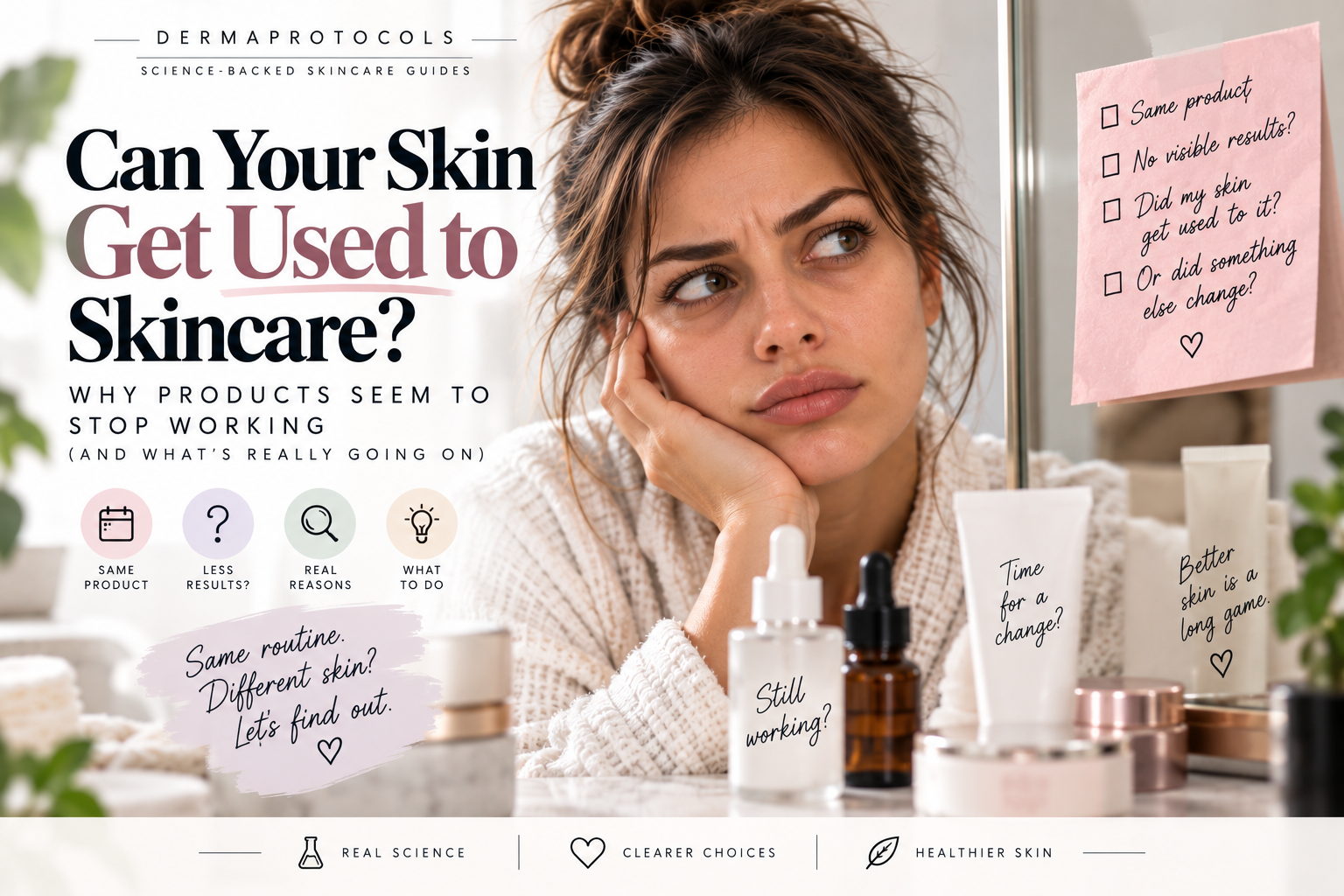
Does Skin Become “Immune” to Skincare?
Usually, no.
Your skin does not normally decide that niacinamide, vitamin C, retinol or hyaluronic acid have had their turn and stop responding because they have become too familiar.
What often changes is the problem, the visible rate of improvement, your routine, your environment — or your expectations.
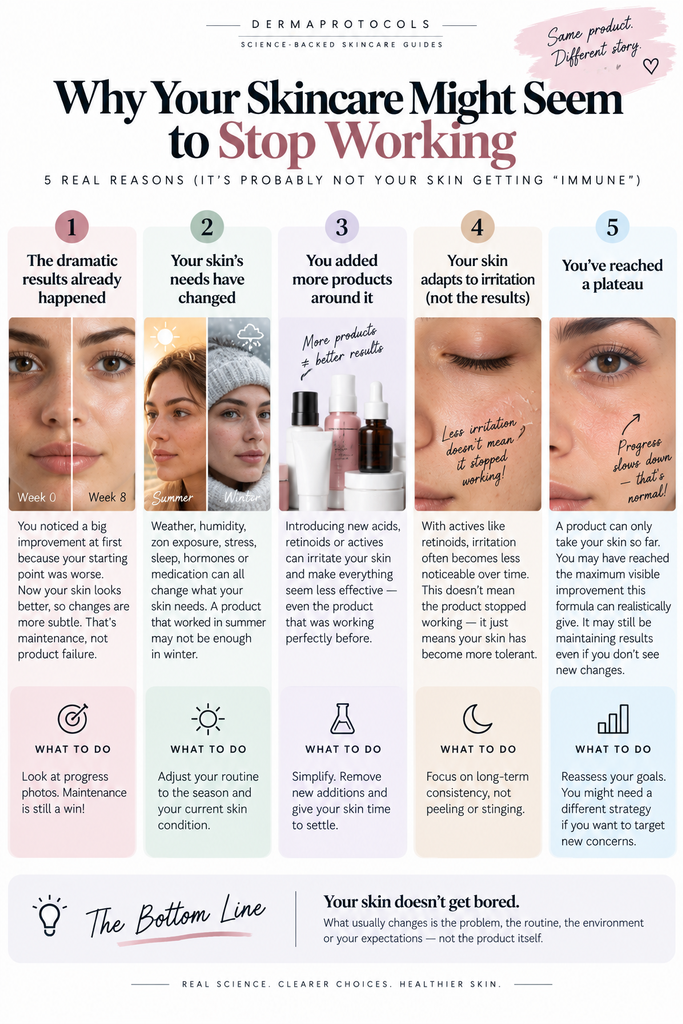
📈 Reason #1: The Dramatic Part Already Happened
Imagine starting with dry, rough skin.
You add a good moisturizer and within two weeks your skin looks noticeably smoother. That first improvement feels huge because the starting point was worse.
Three months later, the moisturizer may still be doing exactly what it was designed to do — helping maintain hydration and barrier function — but there is no longer a dramatic before-and-after happening every week.
Maintenance is much less exciting than transformation.
Think of toothpaste.
You don’t conclude that toothpaste “stopped working” because your teeth stopped getting dramatically cleaner every month. At some point, the job becomes maintenance.
🧴 Reason #2: The Problem Changed
The serum may be the same. Your skin may not be.
Temperature, humidity, sun exposure, sleep, stress, hormonal shifts, medication, cleansing habits and the rest of your skincare routine can all change what your skin needs at a particular moment.
A lightweight gel moisturizer that felt perfect in humid summer weather may suddenly feel inadequate during a cold, dry winter.
That isn’t necessarily product failure.
Sometimes the product didn’t change. The assignment did.
🧪 Reason #3: You Added More Products Around It
This one is extremely common.
Your simple routine worked. Then came:
✓ another exfoliating acid
✓ a stronger retinoid
✓ a new vitamin C serum
✓ a “pore treatment”
✓ an overnight peel
✓ one innocent-looking TikTok recommendation
Now the skin is irritated, dry or inconsistent — and somehow the original serum gets blamed for “not working anymore.”
If everything suddenly seems ineffective, the solution is not always to buy something stronger.
Sometimes it is to simplify.
🔥 Is everything suddenly stinging?
That points in a very different direction from “my product stopped working.” Read: Why Does My Skin Burn After Everything I Apply? The 3-Step Sensitive Skin Rescue Protocol .
🧬 Reason #4: Your Skin May Adapt to Irritation — Not Lose the Benefit
Retinoids are where this myth becomes especially confusing.
When someone first starts a topical retinoid, dryness, peeling, stinging or redness can be more noticeable during the early weeks. Clinical guidance recognizes that this irritation often becomes more manageable over time.
People then sometimes assume:
“It doesn’t sting anymore, so it must have stopped working.”
That conclusion does not follow.
Less irritation is not evidence that the active has stopped doing its job. Burning and peeling are side effects — not proof of efficacy.
RETINOID REALITY CHECK
🔥 More peeling ≠ more anti-aging benefit
😌 Less irritation ≠ product stopped working
📅 Long-term consistency usually matters more than chasing a stronger reaction
If you’re choosing a gentler entry point rather than chasing irritation, see the CeraVe Skin-Renewing Retinol Serum Review or our Medik8 Crystal Retinal 3 Review .
📉 Reason #5: You’re Seeing a Plateau
A skincare plateau can be real without meaning the product has become useless.
Suppose a product improves a certain concern by a meaningful amount. Eventually, you may reach the level that this particular formula can realistically achieve.
Continuing it might help maintain that result — but it may not keep producing new visible improvements forever.
Skincare is not a video game. You don’t automatically unlock Level 12 skin because you used the same serum for six months.
🧠 Reason #6: Your Brain Adapted Faster Than Your Skin
There is also a very human explanation.
You notice change most when it is new.
If your skin becomes brighter, smoother or less dry gradually, that improved version eventually becomes your new normal.
You stop comparing today’s skin to six months ago. You compare today’s skin to yesterday.
And yesterday looked pretty similar.
Sometimes your skincare didn’t stop working.
You stopped noticing the work.
📸 The Test: Don’t Trust Your Memory
Before replacing a product, compare:
📷 Photos taken in similar lighting
📅 At least several weeks apart
🧴 The same basic surrounding routine
🌤 Similar seasonal conditions when possible
🎯 One specific concern — not “does my face look better?”
A bathroom mirror at 7 AM and a selfie under office lighting at 3 PM are not a controlled skincare trial.
🔄 So When Should You Actually Switch Products?
There are situations where changing the product makes perfect sense.
| What You’re Seeing | What It May Mean |
|---|---|
| No meaningful improvement after an appropriate trial | The product may simply not be a good match |
| Persistent irritation | Tolerability matters more than “pushing through” |
| Your main concern has changed | Your routine may need to change too |
| The formula has oxidized, degraded or expired | Replace the product, not the entire skincare philosophy |
| You reached a realistic plateau | Maintenance may be the current benefit |
🛑 DON’T BUY ANYTHING YET
Do This 5-Minute Routine Audit First
1. What exact problem was this product supposed to solve?
2. Did it improve that problem at first?
3. Did you add anything else since then?
4. Did the weather, season or your skin condition change?
5. Are you expecting maintenance to look like continuous transformation?
If you can’t answer those five questions, your credit card can wait.
⚠️ One Important Exception: Medicines Are Different
The casual phrase “my skin got used to it” should not be applied universally to prescription or medicated topical treatments.
True pharmacologic tolerance — often called tachyphylaxis — has been studied with certain topical drugs, particularly corticosteroids, although its clinical relevance is more complicated than the internet version of “your skin becomes immune.”
Medication schedules should therefore be changed according to medical guidance, not because a cosmetic skincare myth said every topical product needs a break.
💊 PHARMACIST’S REALITY CHECK
Your Skin Doesn’t Get Bored.
Cosmetic ingredients do not become ineffective simply because your skin has seen them many times before.
What you’re more likely to be seeing is:
a plateau,
maintenance,
a changing skin problem,
an overloaded routine,
or changing expectations.
Before increasing strength, frequency or the number of actives, figure out which one applies.
🧠 MYTH FILE VERDICT
Can Your Skin Get Used to Skincare?
❌ SKIN BECOMES “IMMUNE” TO YOUR SERUM → USUALLY NO
📉 VISIBLE RESULTS CAN PLATEAU → YES
😌 RETINOID IRRITATION MAY BECOME LESS NOTICEABLE → YES
🔄 YOUR SKIN’S NEEDS CAN CHANGE → ABSOLUTELY
Don’t replace a product because the excitement disappeared.
Replace it when the reason for using it no longer makes sense.
🔬 The Science Behind the Myth
Topical Retinoid Tolerability
Clinical evidence shows that retinoid-related irritation is particularly relevant during the first weeks of treatment, with tolerability influenced by formulation, concentration and skin type.
View the study on PubMed →
Managing Retinoid-Induced Irritation
Recent clinical guidance emphasizes that early irritation can often be reduced with gradual use, moisturization and appropriate supportive skincare rather than assuming irritation is necessary for efficacy.
View the study on PubMed →
Retinoid Irritation & Formulation
A 2024 review describes strategies used to reduce retinoid-induced irritation, including delivery systems, barrier-supportive ingredients and improved hydration.
View the review on PubMed →
Does True Topical Tachyphylaxis Exist?
Pharmacologic tolerance has been studied with topical corticosteroids, although reviews note that clinically meaningful loss of therapeutic efficacy is not as straightforward as commonly assumed.
View the review on PubMed →
Keep Reading
🔥 Why Does My Skin Burn After Everything I Apply? The 3-Step Sensitive Skin Rescue Protocol
🌙 CeraVe Skin-Renewing Retinol Serum Review: Gentle Anti-Aging
✨ Medik8 Crystal Retinal 3 Review: The Gold Standard for Vitamin A Beginners
Editorial note: This article refers mainly to cosmetic skincare. Prescription treatments and medicated topical products may behave differently and should be used according to professional guidance.